







The real estate asset class stands at a curious juncture. Despite a soft economic backdrop, occupier markets are holding up better than expected. Demand for high-quality, well-located, and operationally efficient buildings continues to drive rental growth, which in turn is supporting a slow but steady recovery in capital values. Yet the capital markets remain somewhat disconnected. Investment volumes have improved, but the urgency to deploy capital is still lacking.
Many point to interest rates as the culprit. But across Europe, five-year euro interest rate swap rates have already fallen around 100–125 basis points from late 2023 highs, and in many markets, all-in rates are now accretive to real estate returns. Others cite geopolitical and economic uncertainty, though long-term investors should look through short-term noise. Positively, measures of financial anxiety such as the VIX and credit spreads suggest investors are learning to live with the noise.
More fundamentally, real estate is having to work harder to compete for capital. Investors can now choose from private credit, infrastructure, and other asset classes that promise strong risk-adjusted returns. As a result, real estate faces more pressure to earn its place in a portfolio. Encouragingly, while alternative strategies are growing, survey data, including the 2025 Hodes Weill real estate allocation monitor, suggest allocations to real estate remain stable, implying that the asset class remains a core component of institutional portfolios. But that position can’t be taken for granted and must be earned through performance.
There are very good reasons to be upbeat on the asset class. Capital values have stabilised and are starting to tick higher again, but still remain close to cyclical lows, creating an appealing entry point for both equity and debt investors. This recovery is also different to previous cycles. The last two years has all been about a cost of capital reset, necessitating outward shifts in real estate yields. At the same time rents have continued to rise despite the soft economic backdrop. Something that we hadn’t seen before in previous cycles over the past three decades. Moreover, we haven’t seen rental growth this strong since before the GFC (Chart 1).
Chart 1: Europe prime all-property capital growth by component & 10-year German bund yields
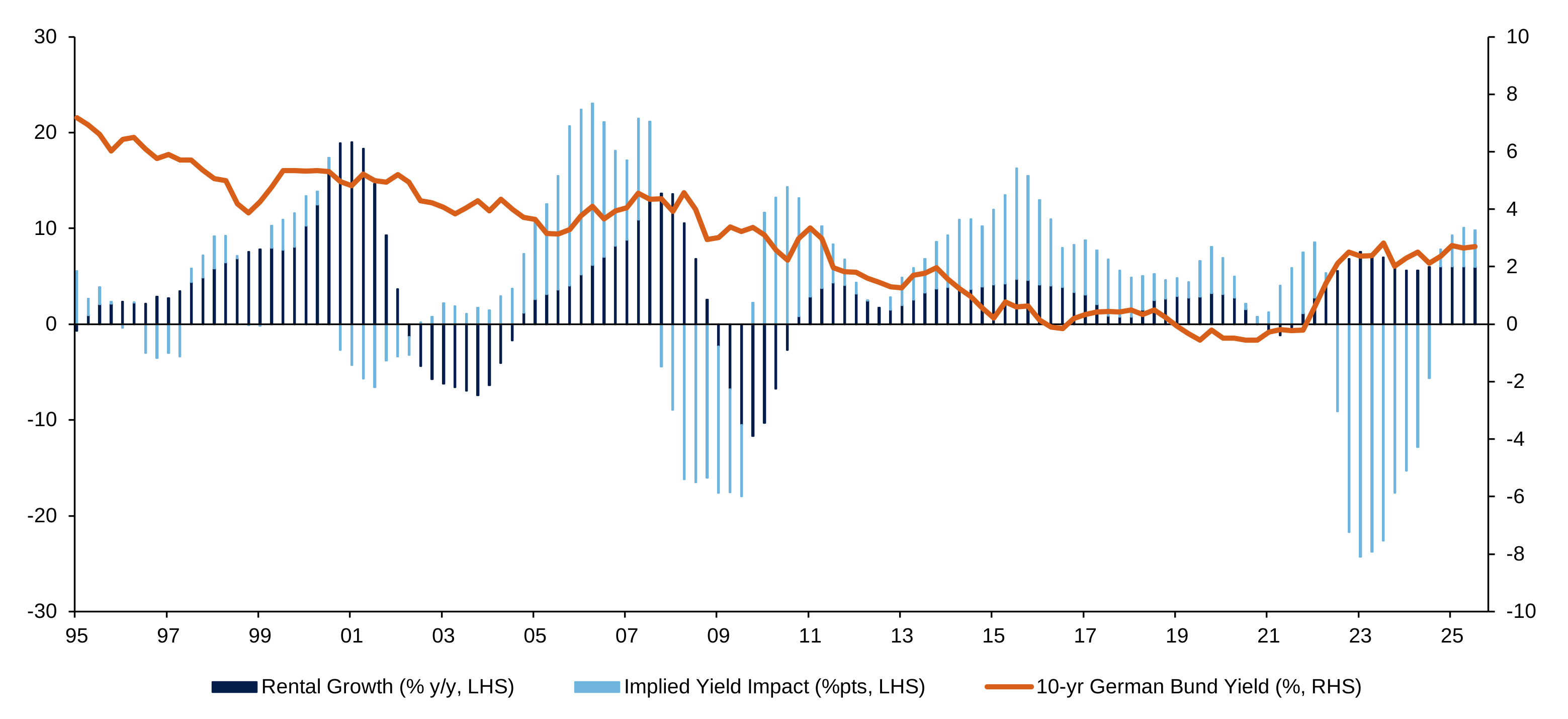
Source: CBRE, Savills IM (Oct 2025)
As we have argued previously, in a world defined by a higher cost of capital, investors need to think and act differently, focusing on income and income growth – working assets harder to deliver outperformance, rather than relying on yield compression to do the heavy lifting. The past year has reinforced this view and the benefit of concentrating on resilient sectors that offer long-term, durable income streams with downside protection. Thematic strategies – those backed by enduring demand-supply fundamentals – remain the best hunting ground: residential, including student accommodation; industrial and logistics (particularly smaller formats); food retail; discount- and convenience-led retail parks; and data centres. We don’t expect this cycle to just be about sector allocation. Rather, investors will need to put more emphasis on asset selection and operational excellence. Indeed, the ability to generate enduring cash flows and grow net operating income will play an important role in relative performance.
Positively, economic forecasts suggest we could start to see some brighter days in the latter part of 2026 and into 2027 which should give the occupational market a boost. With many markets characterised by low supply – particularly for modern, operationally efficient buildings – due to higher financing and construction costs, conditions should be conducive to on-going rental growth. The sharp rise in build costs means that investors currently have the opportunity to take advantage of market dislocation and acquire strong assets at below replacement cost.
Constrained development pipelines and a flight to quality across real estate sectors also marks out a number of tactical opportunities, particularly for core CBD offices, select high street spaces and dominant shopping centres which are all seeing renewed interest. It also presents opportunities for value-add strategies for unloved, but ultimately well-located assets. The recovery in capital values between prime and average office assets for example highlights the importance of asset selection and asset quality (Chart 2).
Chart 2: European prime & average office capital values* (Indexed, Q1 2023=100)
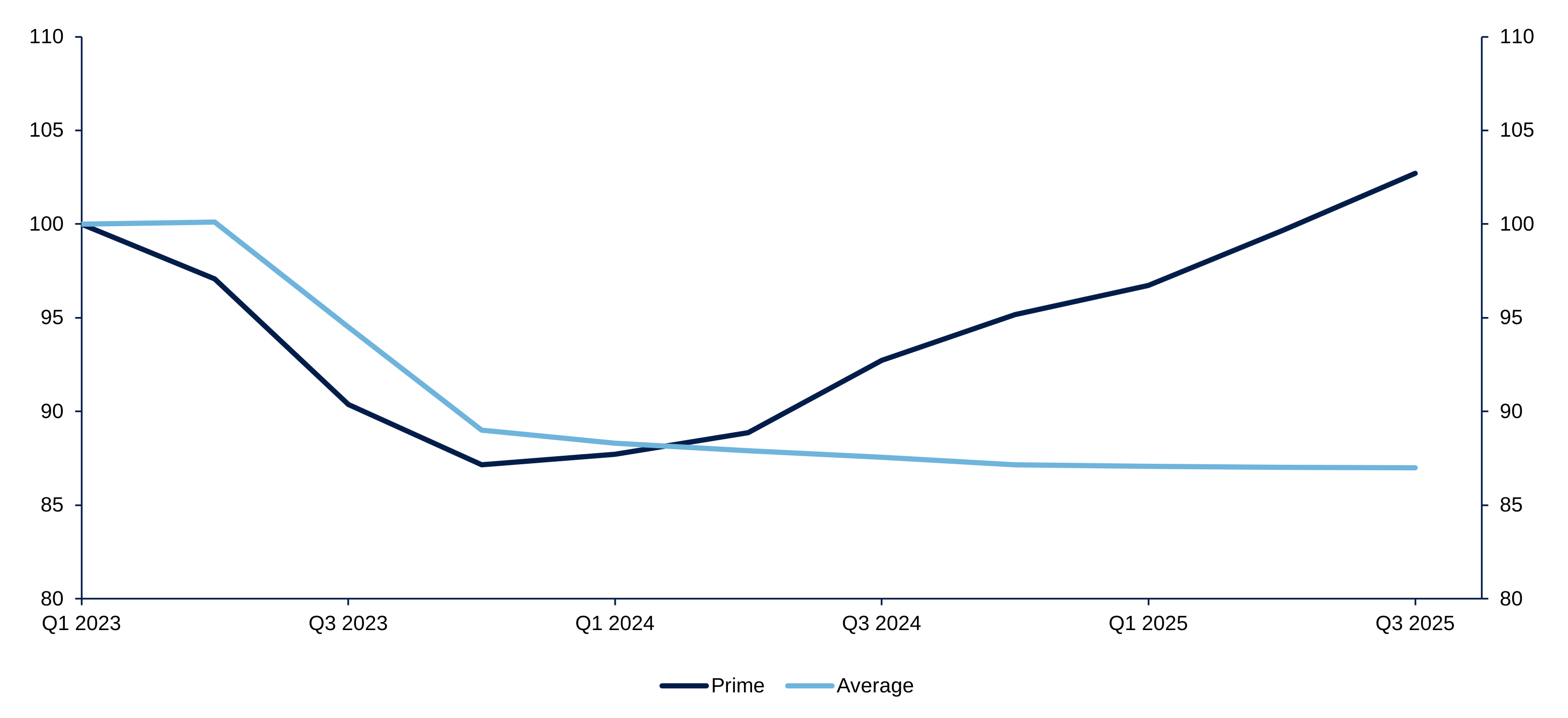
Sources: CBRE, Green Street, Savills IM (Nov 2025)
*Office-stock weighted capital value change of 24 European office markets
The early stages of this new cycle may be slower than many expected. But unlike past recoveries, it isn’t burdened by oversupply. And demand has remained solid. Real estate is still a place where patient capital can earn resilient income through economic ups and downs. What’s more, it retains its ability to generate income growth – something that bonds can’t give you. By tuning out the background noise and focusing on sectors and assets that combine strong fundamentals with operational excellence, investors still have an opportunity to move early in this cycle and create lasting value.