





Still delivering the goods
The challenges facing the logistics sector are manifold. Economic stagnation in Europe, protectionism in the USA, geopolitical conflicts and recurring supply chain disruptions have been challenging the industry for years.
It is therefore no surprise that tenants are hesitant to sign new leases currently and that one may be wondering whether logistics will still be able to deliver the goods (returns). However, the sector is used to challenges, and offering solutions is, after all, the sector’s core competence. Logistics remains high on the popularity scale among investors, thanks to structural demand drivers that are set to strengthen.
Economic recovery supportive, structural drivers strengthening
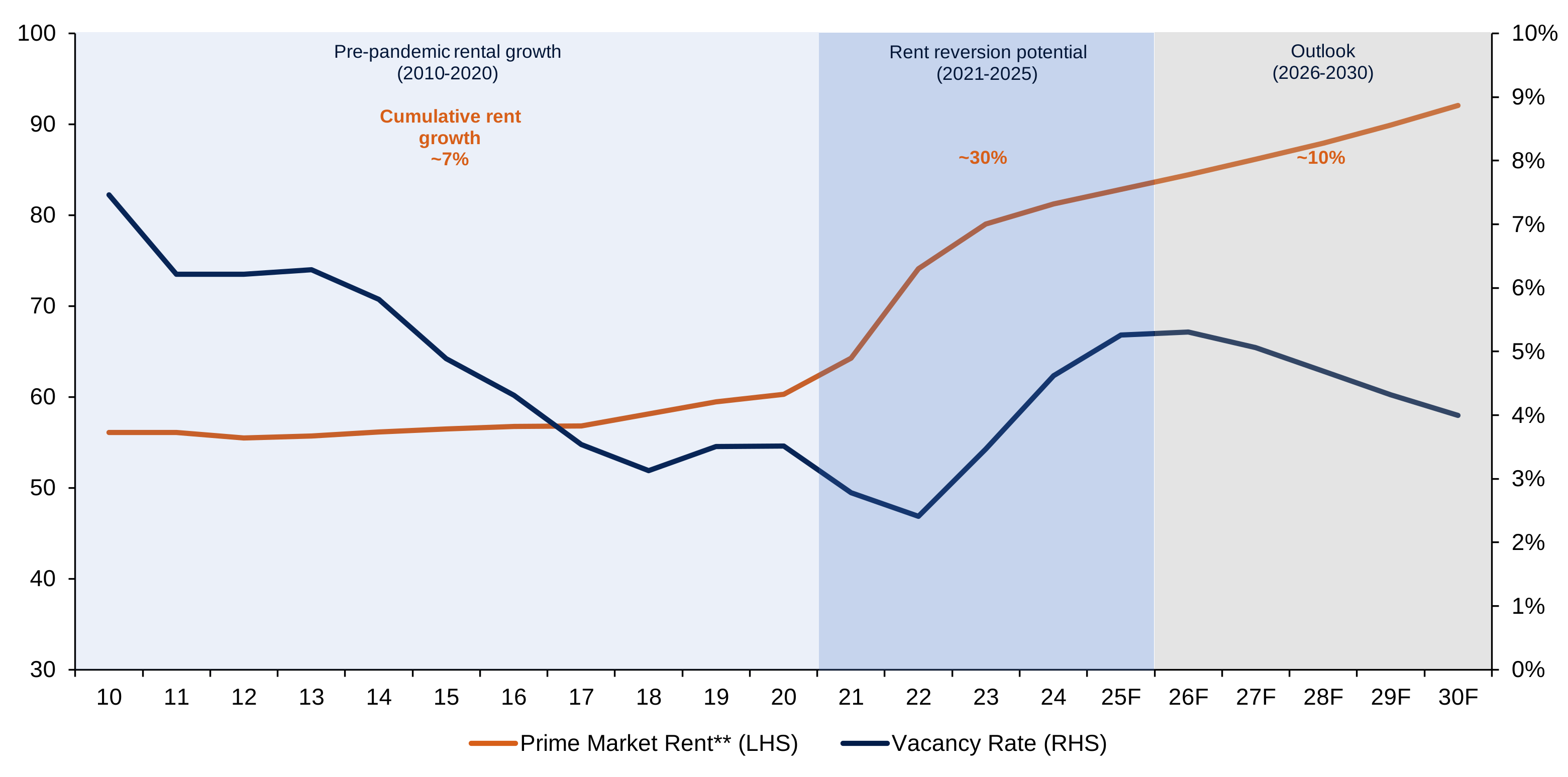
A slow, but notable economic recovery is expected as from mid- 2026 at the latest, which will support leasing markets. Although available modern space has increased in some submarkets, there is no overall supply surplus in Europe with the average vacancy rate standing at around 5% in the core markets. Vacancy rates will likely peak in 2025 as speculative construction slows. The fact that demand for space remains roughly in line with the long-term average even in the current moderate market backdrop is primarily due to structural demand drivers. E-commerce and supply chain shifts drive occupier demand long-term, with nearshoring and defence spending further boosting the sector. Geopolitical tensions and global fragmentation require resilient supply chains. According to Savills, an additional 37 million sqm of logistics space may be required over the next seven years to support the expanding defence industry, though not all of it will qualify as institutional investment product.
Rental growth more moderate, but reversion potential high
Demand for logistics space will pick up again, but rents are likely to grow at a more moderate pace. Nevertheless, the potential to increase income is high, especially in urban locations where logistics demand is healthy and competition for land strongest. Market rents have risen by up to 30% since 2020. This creates substantial income growth potential when re-letting or repositioning existing properties that are under-rented (Chart 1). Are higher rents still affordable? We believe that rental growth is supported by more demanding tenant requirements around location and building quality. Both come at a cost, but also deliver operational efficiencies and thus cost advantages. There will be lower transport costs due to proximity to customers, but also savings through modern building technology and high-performance IT infrastructure justifying it from a business perspective.
Chart 1: European logistics prime rent evolution & vacancy*
Sources: CBRE, Savills IM (Nov 2025)
Future-proof sheds will be smart and eager for (green) power
Increasing the efficiency of logistics operations is the key performance driver for occupiers. The focus is on optimising the supply chain through increasing automation and predictive, AI-driven inventory management in real time for example. This requires smart buildings, which have high and expandable power capacities. Modern sheds are increasingly becoming a technology-driven platform that must be able to adapt flexibly to new digital processes. In addition to a strong IT-infrastructure, the availability of (green) power are becoming decisive location factors, not least because of enhanced ESG requirements.
We believe logistics is still business critical and will continue to deliver the goods in 2026, offering attractive risk-adjusted returns for investors. Demand for modern space is likely to grow further, supported by improved economic conditions, strengthening structural drivers and enhanced occupier requirements on building quality. New construction is coming down matching the slow-down in demand keeping the market in a healthy balance. Rents may appear less affordable compared with historical levels, but this is also a consequence of increased space and location requirements. Future-proof logistics space should be both smart and close to customers enabling efficiency gains and cost savings that compensate higher rents for occupiers.
*Eight largest logistics markets in Continental Europe
**Weighted average prime rent (EUR/sqm/pa)