







Resilient income built on solid foundations
The investment fundamentals underpinning the living sector are well established. Enduring demand and a structural undersupply of housing make the sector a core allocation for long-term capital seeking stable income streams. Furthermore, as a less cyclically driven sector, it provides resilience through the economic cycle.
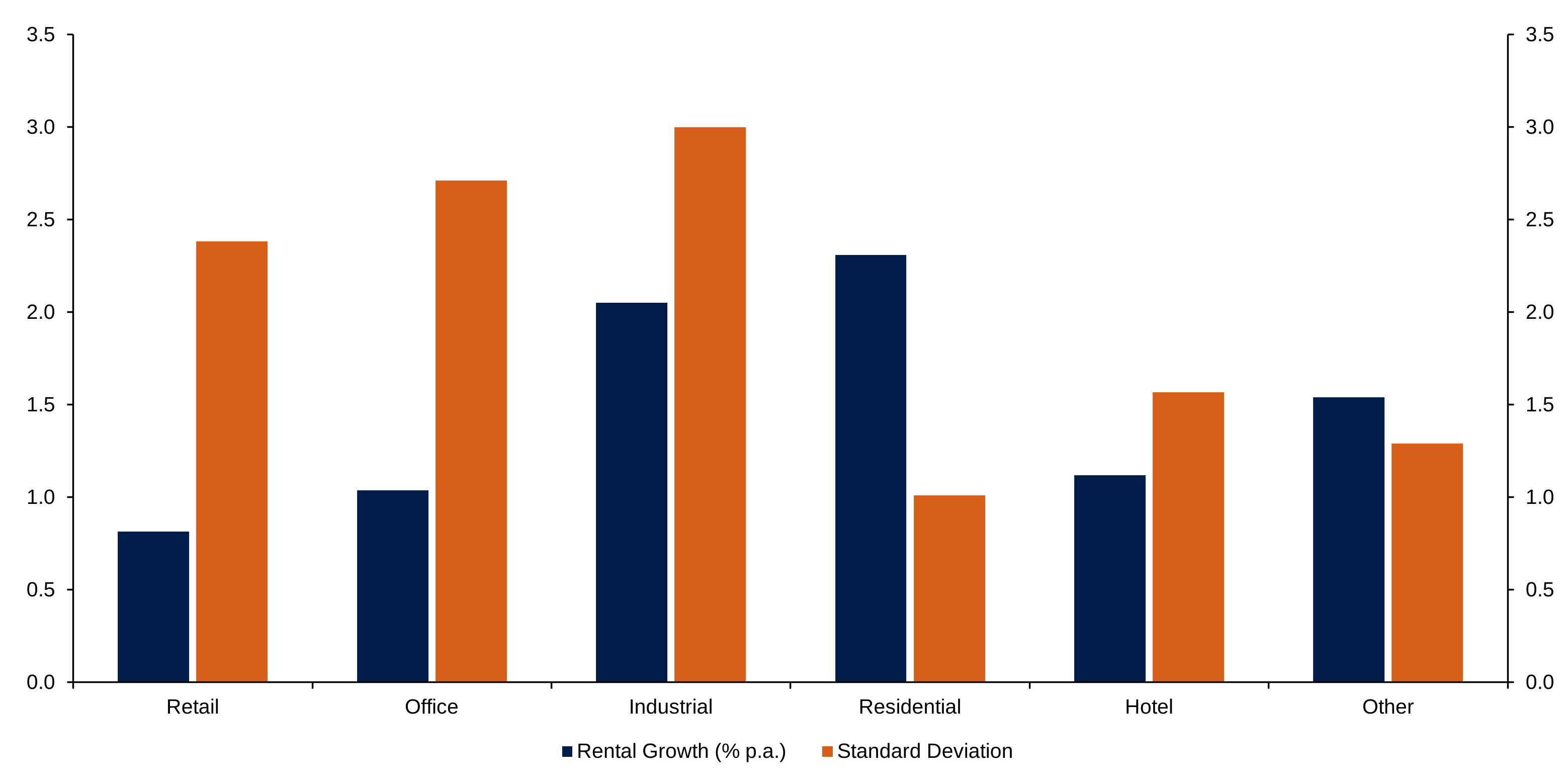
Despite defensive income characteristics and steady capital appreciation (on a rolling five-year basis the sector has never recorded a decline in capital values since 2001)1 a common riposte from investors is that residential is too low yielding relative to other real estate sectors and fixed income. However, this overlooks the attributes that justify lower yields – namely, an on-going demand-supply imbalance, low vacancy risk and steady rental growth. In fact, the European residential sector has generated the strongest long-term average annual rental growth with lower volatility, outperforming all other sectors (Chart 1).
Chart 1: European real estate rental growth, 2001-24
Source: MSCI European Annual Index, Savills IM (Oct 2025)
Relative to 10-year government bonds, prime residential assets typically offer a 100–125bps yield spread, with some exceptions. Moving beyond major capitals into strong secondary cities can easily add another 50bps.2 Add in positive long-term rental growth and the potential to generate upside value from improving net operating income (NOI) through operational expertise and you’ve got something that bonds can’t give you.
Across Europe, net operating costs averaged 26% of gross income in 20243. Reducing these costs directly lifts NOI. Within and across countries the range of income leakage will be wide given the disparity of asset quality and age of construction. For older assets there is an opportunity for investors to improve asset performance through enhanced energy efficiency measures, in some cases benefitting from government-backed initiatives such as in Germany which can enhance the investment case. Efficient buildings not only align with sustainability goals but are also likely to benefit from lower tenant turnover, reduced void risk and stronger tenant retention. For newer assets, this is about maintaining asset quality to minimise the future income leakage as the building ages.
Rental affordability constraints and regulatory risk are often cited as concerns for potential investors. Yet both are manageable through disciplined market selection and active asset management. Affordability is complex and highly local. The key is to target markets where rents remain sustainable relative to incomes thereby supporting long-term occupancy and minimising void risk.
Rent controls, often viewed as a threat, can in fact enhance income predictability. Where uplifts are capped during tenancies but reset between them, leases resemble commercial index-linked arrangements – long regarded as desirable by institutional investors. Thus, rent regulations need not be a barrier to entry as long as it is appropriately underwritten.
At its heart, residential is an operational asset class. Every subsector – multifamily, singlefamily, student or affordable housing – comes with its own nuances. Yet the core proposition remains: the stability of bond-like income with the potential for income growth. It may yield less upfront, but that reflects genuine resilience and lower volatility. The ability to maximise operation efficiency and grow NOI overtime should be investors focus, not the entry yield. Supported by enduring supply-demand imbalances and robust long-term fundamentals, we believe the living sector remains one of the most compelling longterm plays in European real estate.
1 Savills IM calculations based on the MSCI European Annual Index
2 Savills IM calculations based on Macrobond & CBRE data
3 MSCI European Annual Index