







European residential real estate combines structural housing shortages, powerful demographic demand and rising replacement costs with stable income growth. Over the past 20 years, it has outperformed all property returns by 100bps annually with lower volatility.
For long-term investors who can look beyond the initial yield, the residential sector offers inflation protection, defensive cash flows and operational upside that bonds simply cannot match. Read our article from Financial Investigator’s June 2026 release and for the full issue please visit their website.
A common critique of the European living sector by investors is that yields are too low compared to other real estate sectors or asset classes like government bonds, particularly with the rising cost of debt. At face value, this seems hard to argue against. Why acquire a prime residential asset at 3.50% when you can buy 10-year government debt at 3.00% and avoid significant real estate transaction costs and the subsequent hassle of having to deal with tenants, capex and opex, or changes in government regulation.
Yet according to surveys, residential remains a favoured sector for real estate investors, having topped INREV’s Investor Intentions Survey of preferred sectors in Europe for three years running. So how do we square this, or is it a case of perception not matching reality?
In our view there are three key reasons why viewing the residential sector through a ‘low yield’ lens is too simplistic.
1: Supportive Fundamentals
First, investing in the residential sector has never been about headline yields. Rather, its attractiveness comes from the supportive fundamentals that provide stable income streams and drive rental growth. Long-term structural demand continues to collide with a systemic failure to build enough houses, creating scarcity dynamics and, consequently, long-term capital value growth.
This matters enormously from an investment perspective because supply-constrained sectors tend to exhibit stronger pricing power and lower void risk. Even during periods of economic weakness, residential occupancy and rent collection levels remain high relative to commercial property sectors as people still need a place to live.
Office demand, for example, can evaporate when companies delay leasing additional space, downsize, or go bust. With a very broad tenant base, losing one residential tenant rarely creates a catastrophic income event. Losing a major commercial tenant can destroy cash flow underwriting overnight. In other words, residential offers investors a sector with more durable income streams though economic cycles and periods of geopolitical turbulence.
Across much of Europe, housing supply has failed to keep pace with demographic and urbanisation trends for more than a decade. Population growth, a structural shift towards smaller households and immigration have all increased housing demand in cities. At the same time, planning constraints, increasing regulatory complexity and rising construction costs, which have surged in recent years, are restricting development.
Residential construction costs throughout Europe are more than 20% higher today than the longer-term pre-pandemic trend would have implied. It is striking that Vonovia, Germany’s largest listed residential landlord, notes that the key to unlocking development lies in lower costs, and has set a construction cost target which is 30% below market costs.¹
Crucially, in the absence of significantly lower construction costs or higher rents to make new development schemes viable, the supply-demand imbalance is likely to persist for some time. Not only are investors buying into stable income streams and rental growth potential, they are also acquiring increasingly expensive and hard-to-replace urban housing stock, supporting long-term values.
2: Outperformance vs Inflation
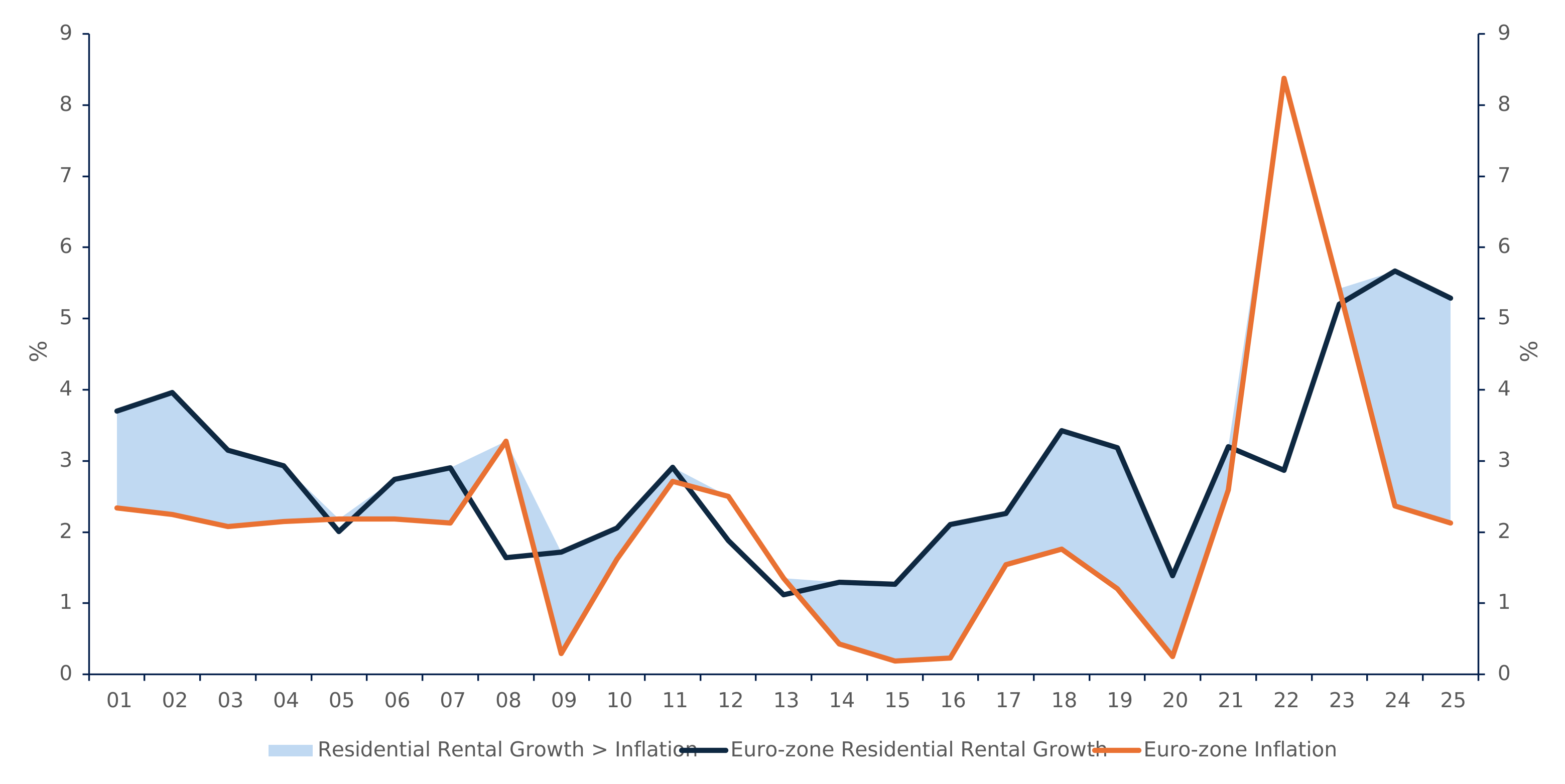
The second point is that investors shouldn’t evaluate the residential sector (or in fact any other real estate sector) solely through a yield comparison against bonds. Bonds may currently offer attractive nominal yields, but they do not provide income growth. A government bond yielding 3% today will still yield 3% tomorrow. Over the past 25 years, the compound average annual rate of inflation across the euro-zone was 2.1%. Average residential rental growth was 2.8% over the same period (Chart 1). A cumulative real outperformance of 17%.
Chart 1: Euro-zone Residential Rental Growth Versus Euro-zone Inflation
Source: Savills IM
The fact that residential leases tend to be shorter enables a faster periodic repricing of rents, meaning investors are better placed to offset inflationary pressures on income streams quicker than other real estate sectors. In our view, this element of inflation protection coupled with income stability justifies a lower yield compared to more cyclical asset classes.
3: Attractive Risk-adjusted Returns
Third, total returns from the sector have consistently outperformed other real estate even with lower initial yields, generating an average 100bps per year return premium over the all-property average over the past 20 years.² When coupled with lower volatility, this creates a fundamentally different risk profile: one that should appeal to long-term capital seeking attractive risk-adjusted returns that are more defensive during downturns.
From a portfolio construction perspective, this has significant value. Institutional investors increasingly focus not just on maximising returns, but on achieving resilient risk-adjusted performance. Residential’s relatively stable cash flows can help dampen portfolio volatility and improve diversification outcomes, particularly during periods when more cyclical sectors experience sharper repricing.
The recent correction in pricing since mid-2022 is a good example. While average residential values recorded a peak-to-trough fall of 15%, average industrial values declined by 21% and office values by 23%.³
Thus, focusing on day-one yields is, in our view, the wrong approach to compare the investment characteristics of residential with other asset classes. What’s more, higher interest rates have unquestionably changed the real estate landscape. Investors can no longer rely on yield compression to drive returns. Instead, they will need to focus on income, income quality, and rental growth potential to drive performance. In this regard, investing in sectors like residential benefits from structural tailwinds that are supportive of income growth.
Modern, energy-efficient buildings in strong urban locations are attracting increasing tenant demand and institutional capital. With a large portion of Europe’s residential stock being old, energy inefficient or poorly configured for modern living preferences, the sector also offers significant scope for investors to actively manage assets and capture embedded value through operational improvements. Thus, investors capable of upgrading residential assets and adjusting income relatively quickly to reflect market conditions may benefit from both stronger rental performance and superior liquidity over time, thereby boosting returns for little additional risk.
None of this means residential is immune from challenges. Regulation, affordability concerns, and political intervention remain material considerations. Arguably these risks are being better understood and reflected in pricing and strategy decisions. The real challenge arises when regulation is unpredictable or politically reactive, which undermines underwriting confidence and discourages investment.
Ultimately, the investment case for European residential should not be built on short-term yield maximisation. Rather, on durable long-term fundamentals: structural undersupply, demographic support, resilient demand, income growth and defensive portfolio characteristics. This combination of fundamentals, coupled with the potential for real income growth that other asset classes like bonds can’t achieve, can justify lower yields and is attracting long-term core capital. The real challenge isn’t the day-one yield. It’s maximising operational efficiency to drive NOI growth.
1-Vonovia FY 2025 Earnings Call Presentation
2-Savills IM calculations using MSCI Europe Annual Index (May 2026)
3-Savills IM calculations based on MSCI European Quarterly Index (May 2026)