







Why is European Purpose-Built Student Housing (PBSA) rising up investor wishlists, and what makes for an attractive PBSA opportunity? Read our article from Financial Investigator’s September 2025 release and for the full issue please visit their website.
Top of the Class
The appeal of PBSA to real estate investors is growing rapidly. In the recent 2025 INREV Investor Intentions survey, student accommodation ranked as the third most preferred sector to invest in, with 67% of respondents selecting the sector. Well above its five-year average of 35% of respondents, with only residential and industrial and logistics scoring higher.
But why exactly is European PBSA is rising up investor wishlists? Here are three key factors:
1) Strong domestic & international demand: With a quarter of the world’s top universities (71 in the world’s top 250 ranked institutions and more than 150 in the top 500)1, the quality of Europe’s higher education institutions is attracting a growing number of international students. In addition, rising domestic demand and a large domestically mobile student population is supporting demand for better quality, well-located, amenity rich PBSA.
2) Lack of supply: Just one-in-five domestically mobile and international students are currently able to access a PBSA room. Indeed, despite continental Europe having three times as many domestically mobile and international students as the UK, it only has a similar number of private PBSA beds, suggesting a huge untapped opportunity for investors2.
3) Stable income: Such is the lack of quality accommodation to meet growing student demand, the sector benefits from high, and stable, levels of occupancy, supporting steady, secure income streams.
As with any investment, there are always risk factors that investors need to consider. Three key risks when it comes to European PBSA are potential demand risks (including online teaching); the affordability of study and living costs; and operational considerations. We explored these risks in a paper, European PBSA 101: Top of the Class.
So with Europe’s PBSA sector offering investors an attractive, scalable opportunity, the obvious question to ask is how can investors understand the relative merits of each potential market and determine favourable investment locations and assets.
In other words, where and how should investors access the asset class.
Finding Distinction
We do this through our three-step ‘CLAS’ framework.
We start at the Country level to provide an overall broad perspective of the sector. Next we focus on Location and city-level metrics. As a final step – acknowledging that the ultimate returns and investment performance achievable is inherently linked to the asset – we analyse a set of Asset-Specific variables
Our approach focusses on weighing up the relative pros and cons of each market, including investment and operational risks, and therefore the trade-offs that allow investors to develop an optimal investment strategy to meet their return requirements.
Savills IM’s PBSA CLAS framework
Step I – Country
At Step I we look at country-level factors relating to the size and quality of the education sector, the number and growth of domestically mobile and international students, PBSA provision rate, market liquidity and regulation.
Step II – Location
Here we assess a similar set of six factors as at the Country level, but with some adjustments for relevant city factors which could alter demand-supply imbalances one-way or another and therefore ultimately the performance of an asset in that location.
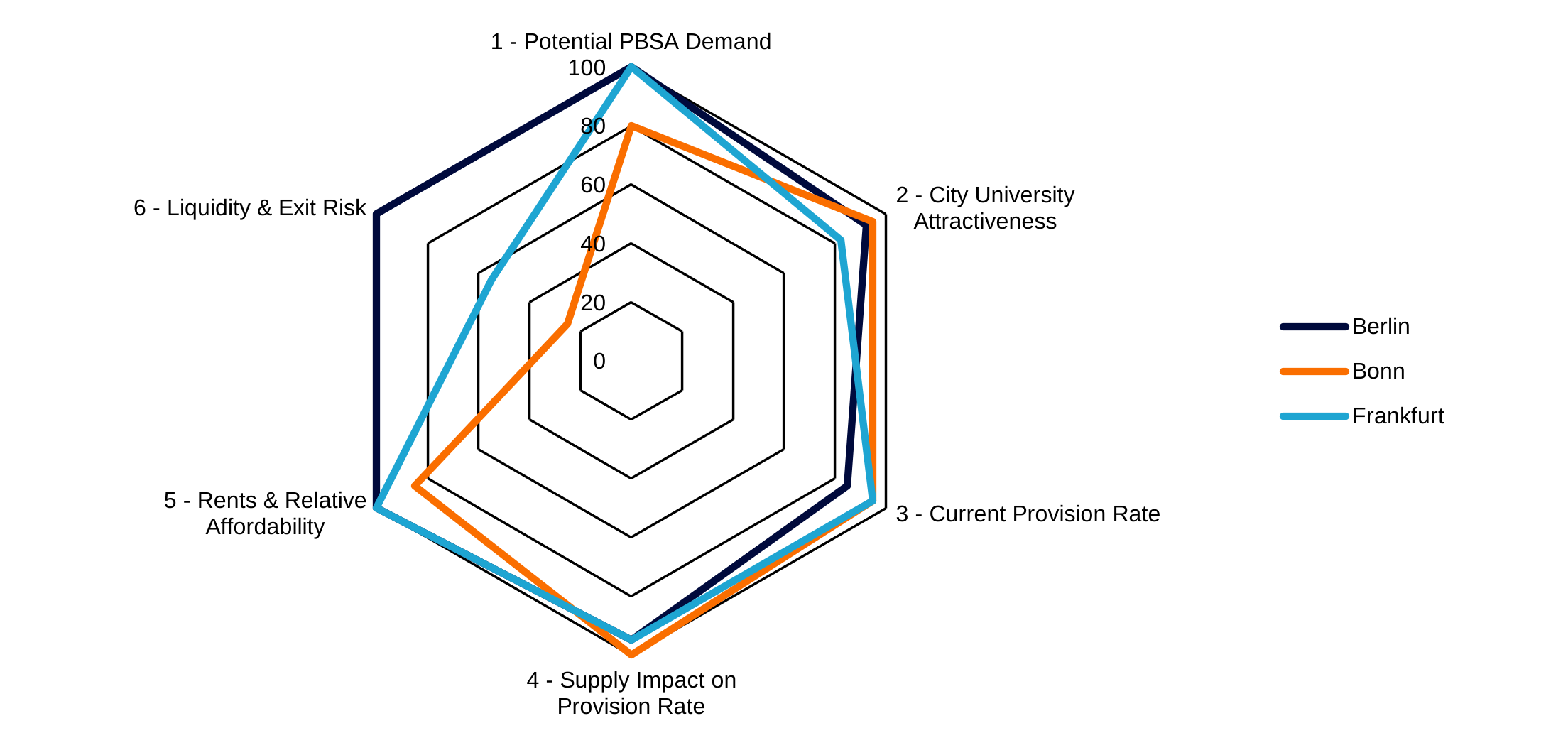
The chart below sets out how we can view the six Location factors with the example of Berlin, Bonn and Frankfurt.
Chart 1: Savills IM CLAS Framework Step II: Analysing Target City Example
Source: Savills IM
Step III – Asset Specific
Finally, the ultimate returns and investment performance achievable by investors depends on the asset. Given the operational complexity of PBSA relative to other more traditional real estate sectors, we add a third step to the analysis, following on from the city identification to ascertain the relative attractiveness of specific assets.
Here we consider factors such as building age, size and quality; location and access to campus; cashflow resilience; pricing; and gross-to-net leakage.
To see the full suite of metrics within our CLAS framework, please read European PBSA 201: Finding Distinction.
As a very city- and location-specific – and nascent – asset class, the question of where to invest is highly pertinent. The CLAS framework isn’t about determining must-have and no-go locations and assets. Rather, it allows us to better understand which locations and assets are likely to produce the risk-adjusted returns that best match investor requirements.
And while Step III delves into asset-specific factors, it is important to highlight that the operational complexity of PBSA compared to other forms of real estate. Indeed, investors have a considerable amount to gain or lose in their understanding of how a PBSA asset is operating.
Masters in Operation
The PBSA sector has idiosyncratic operational risks; students are unlikely to reside in a building for more than a full academic year and as such, investors will need to consider asset-level operational aspects in more detail.
Tenancy duration has a significant impact upon the level and resilience of net operating income realised by the operation, reflecting the exaggerated costs and risks of management when an asset operates on an annual leasing cycle with potentially fluctuating occupancy levels from year-to-year.
PBSA Strategies
High operational factors in and of themselves, shouldn’t be seen as a hurdle to, or discourage, investment. In fact, a Savills & Savills IM (2025) survey highlights increasing flows of investor capital into operational forms of real estate, with PBSA the most sought after operational real estate sector among surveyed investors. The key is understanding current and future operational implications when considering a PBSA investment.
We make the following observations on potential PBSA strategies:
Target inefficiencies: Investors can target discounted operationally inefficient assets and seek to optimise cost and revenue, thereby reducing the gross-to-net income leakage. The risk being that costs are understated and/or that asset improvement takes longer than budgeted for example.
Acquire modern: This approach avoids immediate asset management by acquiring modern, fit for purpose assets at a potential premium but with efficient gross-to-net performance. The risk here is the potential for costs and leakage to increase as the asset ages, capex becomes required and/or occupier demands change.
With all approaches, investors should be mindful of the underlying operational costs and their own risk profiles.
All taken together, it is easy to see why European PBSA is increasingly towards the top of real estate investor’s wish lists.
The PBSA sector presents a strong investment thesis for investors searching for secure income streams with rental growth potential and lower volatility of returns. Low provision rates suggest that the risk to excess supply in most markets is small, even taking into account the existing pipeline. What’s more, it also suggests scope for investors prepared to take on development risk. And as the sector matures, increased liquidity will reduce exit risks, while pairing with operators with local market knowledge is likely to lower operational risks.
1-QS 2025 World University Rankings
2-Savills IM calculations based on Bonard city level data.
NB: Unless otherwise stated, ‘Europe’ in this article excludes the UK.